




Sharon has 21+ years of experience as a qualified Emergency Care Nurse registered with the Australian Health Practitioner Regulation Agency (APHRA) and 12+ years as a First Aid Trainer.
She takes pride in FirstAidPro making first aid training available, comprehensive and affordable to everybody.
Do you remember your days as a kid when you sprained your ankle after an exciting day of sports but then you wondered where the pain was coming from? Did you ever wonder why your mom or caretaker made you elevate your foot and use some relief spray until it healed?
If you are an active person who likes to get physical with martial arts, play active sports, or even just walk the dog in the park every day, you probably deal with a sprain on the ankle more often and now you’re at a point where you want to know how you can avoid it.
You might even have tripped over that invisible step everyone seems to have encountered randomly while walking in public.
Among all the soft tissue injuries, sprained ankles are among the most frustrating.
This blog answers all your pressing questions about your ankle sprain, giving you the exact insider information you sought as a child.
Ankle Strain Vs Ankle Sprain
When it comes to the battle of ankle strain versus ankle sprain, we enter the complex realm of the injured joint, where severe pain reigns supreme.
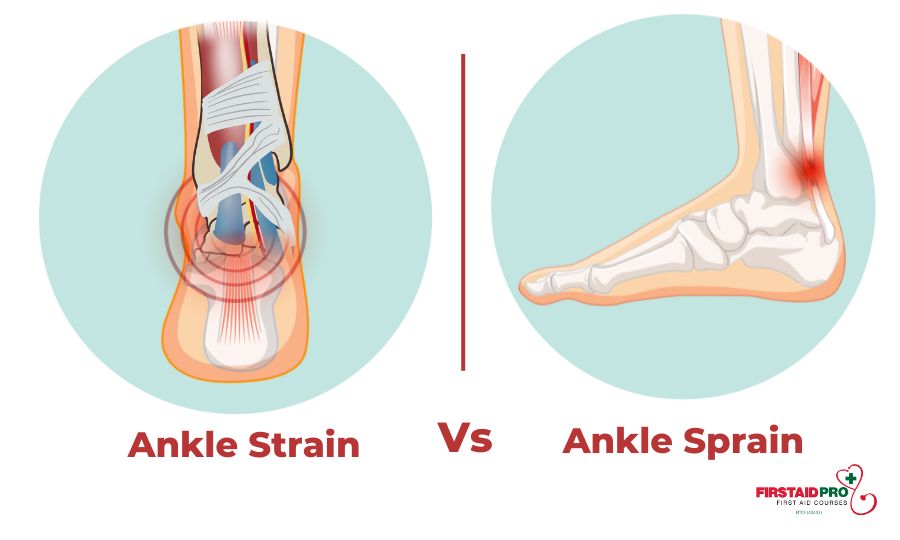
An ankle strain occurs when the muscles surrounding the ankle, those mighty supporters of stability, endure excessive stretching or tearing.
It’s like a warning sign from your body, reminding you to be mindful of your limits during physical activities.
On the other hand, an ankle sprain takes the spotlight when the ligaments, the connective tissues holding your ankle bones together, suffer from sudden twists or wrenches.
This injury can result in significant discomfort, leaving you with an injured ankle that demands attention and care.
Ankle Strain | Ankle Sprain |
Affects muscles surrounding the ankle | Affects ligaments that hold ankle bones together |
A result of excessive stretching or tearing | Results from sudden twists or wrenches |
What Exactly Happens When You Sprain Your Ankle?
The anterior talofibular ligament, calcaneofibular ligament, and posterior talofibular ligament are all injured as the foot rotates inward, which is the enhanced version of foot bruising
Uncommon but noteworthy are sprains that specifically target the ligaments located on the inner side of the ankle, commonly referred to as ‘medial ankle sprains’
Additionally, there are syndesmotic sprains that affect the tibiofibular ligaments, which connect the two leg bones (the tibia and fibula) just above the ankle joint
Syndesmotic sprains, typically observed in contact sports, can have lasting effects by causing chronic ankle instability and increasing the likelihood of future sprains
Types of Sprained Ankle
There are three types of ankle sprains based on how much ligament damage has occurred.
Grade 1 (Mild) – The ligament fibres are stretched slightly, or there is a very small tear.
Grade 2 (Moderate) – The ligament is torn, but it isn’t a complete tear.
Grade 3 (Severe) – The ligament is torn completely.
Ligaments are bands of stretchy, elastic-like tissue that connect one bone to another and hold your joints in place.
A sprain is an injury to a ligament caused when the fibres of the ligament tear or rupture.
The ligament can be strained, partially torn, or completely torn in two.
The last of those possibilities requires surgical intervention to help repair the damaged tissue.
Other Common Sprains
Ankle sprains are the most common type of sprain, but they are not the only type.
Wrist, knee, elbow, shoulder, and thumb sprains are also common for people who play sports.
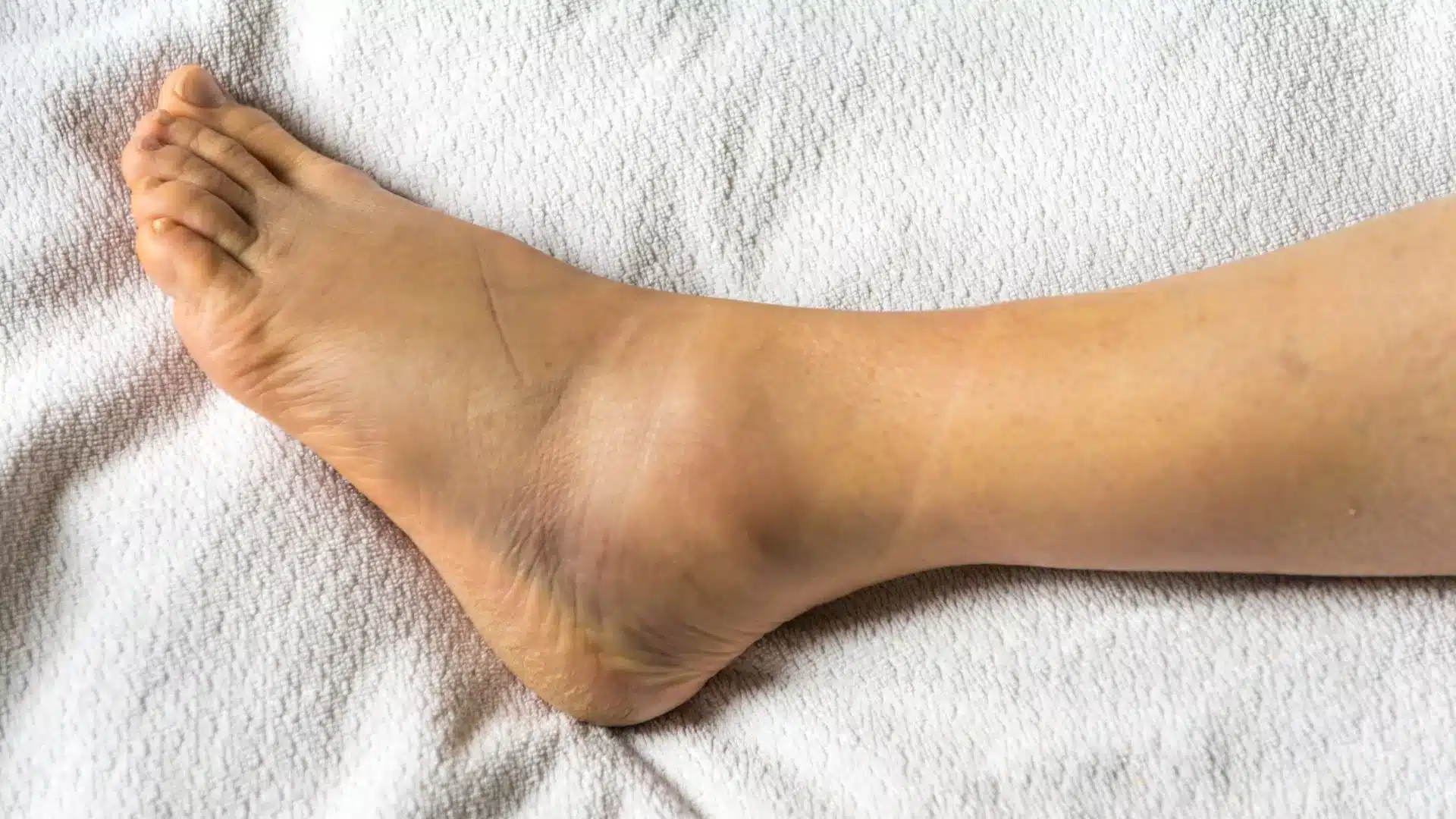
Sprained ligaments will often swell rapidly, bruise heavily and are extremely painful, more so than a broken bone in some cases.
Generally, the greater the pain and swelling, the more severely torn or ruptured the ligament.
For all sprains, you can start initial injury treatment yourself prior to presenting at your G.P. or emergency room for assessment and X-rays to rule out fractures where required.
Strains and sprains are covered in some detail in most first aid courses, so people with a first-aid certificate should generally be your first port of call when someone’s suffered a sprained ankle or similar injury.
If you’re involved in any kind of sport or active lifestyle – or you just like to be prepared – it’s worth investing a day in doing first aid training yourself.
There’s generally a training venue in your local area, and it generally costs less than a tank of petrol does nowadays.
How To Apply First Aid On Your Ankle Sprain?
To treat a sprained ankle, you need to apply R.I.C.E. And no, that’s not going to require a rice cooker. R.I.C.E. is an acronym reminding you of the steps to take when treating a strain or sprain. The steps are:
Rest The Injured Limb
Your doctor may recommend not putting any weight on the injured area for 48 to 72 hours, so you may need to hire or purchase crutches.
A splint or brace also may be helpful initially and, as the weeks pass, offers stability while the ligament repairs.
After the first week, return to your normal routine activity using common sense if the ankle sprain is only mild or moderate.
Ice The Injured Area
Use a cold pack, a slush bath or a compression sleeve filled with cold water to help limit the swelling.
Try to ice the area as soon as possible after the injury occurs and apply the cold compress treatment for 15- 20 minutes.
Ideally, four to eight times a day for the first 48 hours or until the swelling reduces.
If you use ice, never apply it directly to the skin and carefully monitor – particularly around the twelve-minute mark – to prevent damage to the tissue around the injury.
Apply Compression To The Injury
Compress the area firmly but not tightly with an elastic wrap or bandage.
Compressive wraps or sleeves made from elastic or neoprene are the best option and are easily removed, reapplied, washable, and reusable multiple times – these are a must-have item for any decent first aid kit! If such a thing isn’t available, you may have to make do with a firmly wrapped bandage.
Elevate The Injured Limb
Elevate the limb above the level of your heart whenever possible to direct blood away from the injury and help limit swelling.
It’s worth knowing that the R.I.C.E. process is in the process of being reviewed by medical professionals to see if there’s a better alternative – such as the M.E.A.T protocol .
One advantage of having up to date first aid training is knowing that your first aid knowledge is as close to current as you can get.
Why Elevate Sprained Ankle?
Elevation aids in reducing swelling, which is one factor in the treatment of sports injuries.
Increased fluid and white blood cell migration to a particular bodily part causes swelling.
Although there are other causes for swelling, it is a crucial component of the body’s normal inflammatory response.
The wounded part has to be kept out of usage so that your body may work on repairing it, your body is telling you.
How To Strap A Sprained Ankle In 3 Simple Steps:

Make sure you always have a sturdy sports tape in your first aid kid and carry it along with you.
Step 1 – Take your sports tape and strap the first bit a little over your ankle
Step 2 – Move the tape around the heel while leaving the heel free, begin pre-wrapping from above the ankle and below your muscle area muscle area in a dorsiflexed position (raised foot towards the shin)
Step 3 – Run your tape under the heel area from the inside until you get to the end of your food on the bottom side an then gradually work the tape back upwards until it reaches the beginning of the strap, that is the internal side of the ankle bone
It takes two hands to clap, so when you encounter a twisted ankle, first aid is what you need to turn to immediately, but its equally important to give your foot some rest. The next three healing actions involve:
1. Seeking Advice
First and foremost, seek advice from a healthcare professional to ensure an accurate diagnosis and receive appropriate guidance tailored to your specific condition.
2. Resting Up
Next, embrace the power of rest and give your ankle the time it needs to heal. Avoid activities that strain the injured area, as this will allow the delicate tissues to mend.
3. Gentle Movement
Gradually introduce gentle movement and exercises to promote range of motion and strengthen the surrounding muscles.
Can You Still Exercise With An Ankle Sprain?
Even with an ankle sprain, you can still exercise other limbs and muscles to minimise deconditioning (where your muscles grow weak from never being used).
Stationary bike exercise is a great way to still get exercise while you have a sprained ankle and keep up your cardiovascular training and conditioning for the gym junkies.
How Long Does It Take To Recover From A Sprained Ankle?
Ankle sprains can take days or months to recover from, depending on the severity.
As the pain and swelling improve, you should feel a gradual, progressive improvement.
Over-the-counter pain medications, such as ibuprofen and acetaminophen, may be helpful in managing minor pain during the healing process.
Surgical intervention will require prescription medications for pain relief post-surgery but should not be necessary for most individuals after two weeks at the most.
Getting Medical Assistance

Keeping flexibility and restoring strength and stability to the injured limb prior to returning to your pre-injury sports or fitness activity levels is essential.
A physical therapist or other sports medicine provider can provide you with the appropriate strength and stability exercises to optimise healing and offer solutions to minimise the risk of a repeat injury.
Once the sprain has occurred, the area will always be weaker and therefore prone to a secondary injury if the process of rebuilding strength and stability is rushed or ignored.
Any injuries that cause sprains can also cause fractures. See your doctor if your sprain isn’t improving after two days.
Seek emergency medical assistance if you are unable to bear weight on the injured leg, the joint feels unstable or numb, or you can’t use the joint.
This may mean the ligament was completely torn and will require surgical intervention, or a fracture has occurred in either the ankle itself, the tibia or the fibula at the point where they meet the ankle.
On the way to the emergency room, apply a cold pack and elevate the injured limb higher than the heart if possible.
Watch and treat for shock where fractures or grade three sprains have occurred.
If you don’t know how to identify or treat for shock, it might be a good time to enrol yourself into a first aid course.