



Skip to content
Online Courses​
no-Online Courses
Online Courses​
no-Online Courses
no-Online Courses
Online Courses​
Nationally Accredited First Aid Courses
(08) 7120 2570
Firstaidpro Logo
[wp_menu_megatabs id="493"]
Student login
daily deals
No-Online

OR

Online
Applicable to:
Healthcare
Aged Care & NDIS Support
Construction
Warehousing

Defibrillators

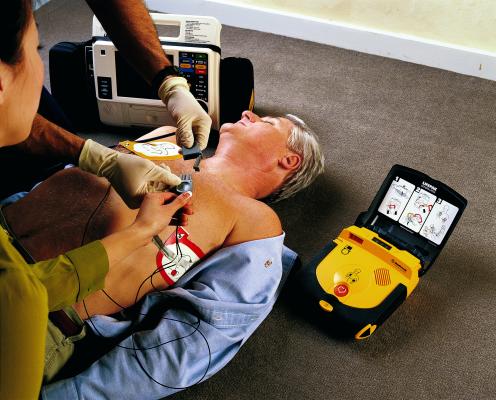
X0000 Physio LifePak CR Plus at EMS handoff copy

Table of Contents

  • About
  • Latest Posts
Sharon McCulloch
Sharon McCulloch
CEO, Founder and First Aid Trainer at FirstAidPro
Sharon McCulloch is the CEO and Founder of FirstAidPro, Australia's leading Registered Training Organisation (31124), delivering First Aid Courses nationwide.

Sharon has 21+ years of experience as a qualified Emergency Care Nurse registered with the Australian Health Practitioner Regulation Agency (APHRA) and 12+ years as a First Aid Trainer.

She takes pride in FirstAidPro making first aid training available, comprehensive and affordable to everybody.
Sharon McCulloch
Latest posts by Sharon McCulloch (see all)
  • Australian Spider Bite & Bite First Aid Guide – Identification, Symptoms & Treatment - 14/04/2026
  • Anti-Inflammatory Tablets – Sting & Bite Symptoms, Risks & First Aid - 10/04/2026
  • LVR CPR Training Australia: What Is the UETDRMP018 Course and Who Needs It? - 08/04/2026

When To Use A Defibrillator?

Defibrillators are designed to re-regulate the heartbeat after a person suffers a Sudden Cardiac Arrest. There is a common confusion among untrained members of the community about the difference between Sudden Cardiac Arrest and a Heart Attack. In reality, the only similarity is that both health emergencies involve the heart. A cardiac arrest is caused by an irregularity in the electrical activity in the heart’s ventricular muscle, commonly known as ‘fibrillation’. When fibrillation occurs, the heart cannot effectively pump blood around the body, which then prompts the heart to go into cardiac arrest.

You Will Know When To Use A Defibrillator If:

  • A person has collapsed on the ground
  • That person is not responding
  • That person is not breathing

Beyond these signs, don’t delay treatment. Each minute without Defibrillation decreases the chances of survival by 10%.

When a person suffers a Sudden Cardiac Arrest, you must first provide CPR to circulate blood and ensure the body remains oxygenated whilst applying a Defibrillator as soon as possible. The electrical shock from the Defibrillator is the only method a First Aider can use to stop fibrillation and return the heartbeat to its healthy rhythm.

Courses You Might Be Interested In:

  • HLTAID009 – Provide cardiopulmonary resuscitation (supersedes HLTAID001 Provide cardiopulmonary resuscitation) 
  • HLTAID010 Provide basic emergency life support (supersedes HLTAID002 Provide basic emergency life support) 
  • HLTAID011 – Provide First Aid (includes CPR) (supersedes HLTAID003 Provide first aid) 
  • HLTAID012 – Provide First Aid in an education and care setting (supersedes HLTAID004 Provide an Emergency First Aid Response in an Education and Care Setting) 
  • HLTAID013 – Provide First Aid in Remote Situations (supersedes HLTAID005) 

How To Use An Automated External Defibrillator?

Automated External Defibrillators are designed for everyday people with little or no training. Depending on the brand of the Defibrillator, it may provide verbal, visual or written prompts on how to use the device. The Philips HeartStart HS1 provides step-by-step verbal clarification on what to do in the case of a cardiac emergency. The Philips HeartStart HS1 will prompt you as follows:

  • Once you ‘ PULL ‘ the lever or press the ‘On’ button, the voice prompt will begin.
  • You will be asked to remove all clothing from the casualty’s chest, cut clothing if required and shave any thick hair. These items should be in the Defibrillator case.
  • It will specify that once the casualty’s chest is bare to take out the white, adhesive pads.
  • The pads have an image on the front which shows how to position the pads on the casualty’s chest. You will be asked to position the pads as shown in the picture.
  • Peel the yellow protector off the pad and press the pad firmly onto the casualty’s skin
  • It will then ask you to look at the picture on the unused pad and position the second pad as outlined in this picture.
  • Peel the yellow protector off the unused pad and press the second pad firmly onto the casualty’s skin
  • You will be told not to touch the casualty so the device can analyse the heart’s rhythm.
  • Whilst analysing the heart’s rhythm, it will announce ‘ ANALYSING.’
  • If it detects that the person’s heart is fibrillating, it will ask you to ‘STAND CLEAR — SHOCK REQUIRED.‘
  • It will ask you to press the orange button then administer the shock. The orange button will be flashing.
  • It will advise ‘ SHOCK DELIVERED ‘ once complete.
  • You will then be prompted to provide CPR. It will talk you through the 120 beats per minute rhythm.
  • Further shocks may be required following continued CPR. Follow the instructions given by the Defibrillator until further help arrives.

What Do You Need To Know About Defibrillators?

  • To remove all clothing from the casualty’s chest.
  • Move necklaces to the side. Piercings do not need to be removed. If piercings have a connecting chain that interrupts the defibrillator pad path, cut the chain
  • If possible, shave casualty’s chest hair where the pads are required
  • Ensure the casualty’s skin is dry, pat down with a towel if required
  • You CAN use a Defibrillator on someone with a pacemaker, place the pad a few centimetres away from the pacemaker scar/area
  • A Defibrillator will not provide a shock unless it detects that the casualty’s heart is in ‘fibrillation’. You, therefore, can do NO HARM by applying a defibrillator to a casualty
  • If a child is under eight years of age or below 25kg, you are required to use child-specific electrode pads. If you do not have these, wait for paramedics to arrive.
Book a CPR Course

The content on this website offers general insights regarding health conditions and potential treatments. It is not intended as, and should not be construed as, medical advice. If you are facing a medical emergency, dial 000 immediately and follow the guidance provided.

Recent Posts
Common Australian Spiders
Australian Spider Bite & Bite First Aid Guide – Identification, Symptoms & Treatment
14/04/2026

An Australian spider bite is common, but serious injury is rare. This guide explains how to identify several Australian spiders, what a spider bite looks …

infected-insect-bite
Anti-Inflammatory Tablets – Sting & Bite Symptoms, Risks & First Aid
10/04/2026

Key Takeaways Anti-inflammatory tablets reduce pain and swelling from insect bites and stings but cannot treat serious allergic reactions or anaphylaxis.NSAIDs such as ibuprofen are …

LVR CPR Training -UETDRMP018 Perform Rescue From A Live Low Voltage Panel
LVR CPR Training Australia: What Is the UETDRMP018 Course and Who Needs It?
08/04/2026

Low voltage rescue (LVR) is the process of safely removing a person from contact with a live low voltage electrical panel and providing emergency care …

CPR and AED
CPR and AED: Why They’re Critical for Saving Lives in Emergencies
01/04/2026

CPR and AED are life-saving first aid techniques used during cardiac arrest to help save lives before an ambulance arrives. When a person’s heart stops …

sprain of the ankle
Sprain vs Strain: Key Differences, Symptoms, and First Aid Treatment
27/03/2026

A sprain is a common soft-tissue injury that occurs when a ligament is stretched or torn, usually after a fall, twist, or sudden impact. Sprains …

Information
  • About Us
  • Contact Us
  • Mental Health Pro
  • Onsite Training
  • Careers
  • Collaborations
  • Course Calendar
  • Daily Deals
  • FAQs
  • Explore Our Courses
  • Instant Price Beat
  • Partners
  • Same Day Certificates
Resources
  • Student Login
  • Blog
  • Learn First Aid
  • Create Your USI
  • Find Your USI
  • First Aid Charts
Popular Courses
  • CPR
  • First Aid
  • Childcare First Aid
  • First Aid Mental Health
  • Remote First Aid
  • Advanced First Aid
  • CPR, Asthma & Anaphylaxis
  • Asthma & Anaphylaxis
  • CPR LVR
  • Manual Handling
  • Manual Handling Refresher
  • Medication Administration
  • White Card
Online Courses
  • Zoom Online CPR
  • Zoom Online First Aid
  • Zoom Childcare First Aid
  • Zoom NDIS HISS Courses
Blended Courses
  • Blended CPR
  • Blended First Aid
  • Blended Childcare First Aid
Charity Courses
  • Free CPR
  • Free First Aid
Locations
  • South Australia
  • Queensland
  • New South Wales
  • Victoria
  • ACT
  • Tasmania
  • Northern Territory
  • Western Australia
Policies & Procedures
  • Academic Honesty
  • Complaints & Appeals
  • LLN
  • Refunds & Cancellations
  • RPL & Credit Transfers
  • Training & Assessment
Firstaidpro Logo
Facebook Instagram Youtube tiktok Pinterest Linkedin
  • Level 3, Unit 6/9 Frinton Street, Southport QLD 4215
  • (08) 7120 2570
  • Get In Touch

FirstAidPro is a leading Registered Training Organisation (RTO: 31124) delivering industry-leading standards and the latest training techniques. We provide you with Australia’s most comprehensive, officially recognised first aid qualification!

  • Same-Day Certificates
  • Courses Available 7 days
  • Nationally Accredited Certification
eway-payment.png
© 2026 Firstaidpro Australia Pty Ltd (RTO: 31124) | ABN: 70 106 788 050 | ACN: 106 788 050 | All rights reserved.
  • Privacy Policy
  • Refund Policy
  • Website Disclaimer
North Hobart