



Sharon has 21+ years of experience as a qualified Emergency Care Nurse registered with the Australian Health Practitioner Regulation Agency (APHRA) and 12+ years as a First Aid Trainer.
She takes pride in FirstAidPro making first aid training available, comprehensive and affordable to everybody.
We use the term adrenaline in a wide variety of contexts. Terms like “adrenaline junkie” and “adrenaline-fueled” are associated with exciting activities like extreme sports, car racing, and theme-park rides. Adrenaline is also related to frightening experiences, and “adrenaline-soaked” can be used to describe a terrifying incident such as a car accident or animal attack. And of course, the term also refers to a common form of medication, and it’s common to hear about people “carrying adrenaline with them”.
If you’re not 100% sure about precisely what adrenaline is, it would be easy to get a little confused about it all.
What Is Adrenaline?
Put simply, adrenaline is a hormone – actually the first hormone ever discovered by medical science (back in 1895). It’s released by your body in times of emergency. It’s part of what’s called your “fight or flight response” when your brain decides that you’re in danger, and you might need to either fight against some threat or run away. The slight tingle you feel when you’re about to do something incredibly exciting or frightening is in no small part due to your adrenaline system kicking in.
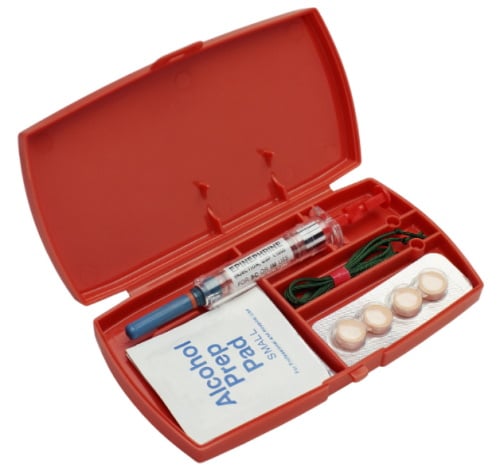
It’s an essential and highly useful hormone. As such, it’s also commonly synthesised in labs and used as a medication – usually in devices such as EpiPens and Anapens.
The word “Adrenalin” (with no ‘e’ at the end) is actually trademarked by an American pharmaceutical company, which has caused some complications over the years regarding use of the word adrenaline. As such, “epinephrin” is also a commonly used name for adrenaline, particularly in America.
What Does Adrenaline Do?
Adrenaline effectively puts your body on red alert – it activates many of your body’s emergency mechanisms. With increased adrenaline in your bloodstream, you’re more aware of your surroundings, you feel less pain, and your reactions are faster. You also have more energy, and you’re capable of feats of strength and endurance that you might not have thought possible.
Effectively, adrenaline switches your whole body into “ready-for-action” mode – ready to fight off an attacker or flee from a flood or fire.
How Does Adrenaline Work?
There’s a lot that goes on in your body when your adrenaline system kicks in. Adrenaline increases the sugar in your bloodstream (giving you extra energy to burn), and opens up your airways. It also dilates your pupils (helping you see better), and contracts blood vessels to redirect blood to muscles and critical organs. All this serves to make you faster, stronger, more aware, and more able to survive danger while the adrenaline is affecting you.
This puts some strain on your body – it’s supposed to be a short term measure. Adrenaline is there to give you a short-term boost to get you through an emergency. Your body isn’t designed to be in danger mode long term.
This isn’t a problem for most people, as your adrenaline system only kicks in when your brain registers danger. But in some situations – such as people suffering long term anxiety – you can end up with elevated adrenaline over a long period. This puts a lot of stress on your body and can have some harmful long term health effects.
In some medical emergencies – such as cardiac arrest or an anaphylactic reaction – the effects of adrenaline can be life-saving.
How Does Adrenaline Work In Anaphylaxis?
Anaphylaxis is a type of severe allergic reaction. It acts very quickly (sometimes in minutes) and can cause a range of reactions in the body, including crippling inflammation, heart complications and life-threatening breathing problems.
It can be caused by various things, with insect bites and stings, food allergies, and medications being among the most common. It’s not always life-threatening, but in some cases can be lethal – generally due to asphyxiation (being unable to breathe) or cardiovascular complications.
This is where adrenaline comes in. Many of the effects of adrenaline on the body can actually help someone survive an anaphylactic attack. In particular, Adrenaline causes the airways to open up and maintains heart function and blood pressure – counteracting the two most significant dangers of anaphylaxis.
Your body naturally releases adrenaline into your system if you’re suffering severe anaphylaxis (being unable to breathe tends to make people feel frightened), but in situations like this, it can do a lot of good to have an extra shot of adrenaline in your system. This is why the treatment for severe anaphylaxis is an extra shot of adrenaline from an autoinjector device. That’s also currently the ONLY treatment.
How To Use An Adrenaline Auto-Injector For Anaphylaxis?
Adrenaline autoinjectors (such as an EpiPen or AnaPen) are becoming quite common nowadays. If you’re known to be prone to anaphylaxis, you may well carry one with you most of the time. Many organisations also regard them as standard first aid supplies for occupational health and safety purposes. As such, you might have one close to hand if a person near you is suffering from an anaphylactic reaction.
When using an autoinjector, it pays to read the instructions carefully. Different autoinjectors work in different ways. The autoinjector should be used on the outer thigh, around halfway between the knee and the hip. Don’t worry about veins – you don’t inject Adrenaline into a vein. You’re aiming for the muscle. You’ll need to hold the autoinjector against the leg for a little while after activating it – the adrenaline needs a moment to go in.
It’s worth knowing that even if you’re not 100% sure what you’re seeing is an anaphylactic reaction, it’s still worth using the EpiPen (or AnaPen). Because Adrenaline is a part of the body’s natural chemistry, you’re not going to do the person significant harm by injecting them when it’s not needed.
And the risks of not treating a potentially lethal allergic reaction are a LOT worse.
You’ll still need to be signalling for medical help – either from a first aid person or by calling for an ambulance. Adrenaline isn’t a cure for anaphylaxis – it just uses the body’s natural processes to provide some short term relief from the symptoms. The danger is still there, and the person still needs medical attention. When medical help arrives, it’s generally helpful to give them the used EpiPen or AnaPen and tell them when you used it.
It’s also worth knowing – adrenaline autoinjectors do have a use-by date, after which they become progressively less effective. It’s always worth checking this date and using in-date adrenaline if possible. However, in a worst-case scenario, outdated adrenaline is better than no adrenaline.
Are There Any Side Effects?
There are potentially a few side effects from using an adrenaline autoinjector. These can include paleness, elevated heart rate, trembling, headaches, and sweating. These are generally relatively short term, however. Adrenaline is part of the body’s normal functions, and it has in-built mechanisms to deal with having too much in your bloodstream.
Being Prepared
It’s worth thinking ahead when it comes to anaphylaxis first aid. If you have someone in your home or workplace who is prone to it, it’s worth knowing if they carry adrenaline on them. It’s also worth checking if your workplace has an EpiPen or AnaPen somewhere handy. And take a few minutes to read through the instructions on the autoinjector when it’s NOT an emergency – so that you’ll have some idea what to do ahead of time.
Ultimately, one of the best things you can do to be prepared for an anaphylactic attack is to get professional first aid training. This will train you to recognise an anaphylactic reaction and give you hands-on experience with an EpiPen or AnaPen – as well as training you for a variety of other emergencies. There are few better ways to prepare yourself than that.