




Sharon has 21+ years of experience as a qualified Emergency Care Nurse registered with the Australian Health Practitioner Regulation Agency (APHRA) and 12+ years as a First Aid Trainer.
She takes pride in FirstAidPro making first aid training available, comprehensive and affordable to everybody.
New data from the Australian Bureau of Statistics (ABS) shows that asthma remains a leading cause of medical emergency. Asthma-related deaths remain stubbornly high, especially for women aged over 75 years. Figures from the National Asthma Council Australia show that in 2020 there were 417 asthma-related deaths recorded, of those people 274 were women and 143 were men.
Asthma Symptoms: Recognising the Signs
Asthma is a medical condition that affects the airways including the breathing tubes that carry air into our lungs from the trachea down into the many branches of the bronchi. People with asthma can experience what is known as an asthma flare up. This is when the airways constrict, making it harder to breathe in and out.
At other times their breathing is normal, but generally, asthma can be controlled through the use of asthma medication and those with it can live long, active and healthy lives despite an asthma diagnosis.
What are the symptoms of asthma?
The most common symptoms of asthma are:
wheezing – a high-pitched sound coming from the chest while breathing
a feeling of not being able to get enough air or being short of breath
a feeling of tightness in the chest
coughing.
Note that you don’t have to have all these symptoms to have asthma, and if you suspect you may have asthma you should speak to your doctor.
When Asthma Turns Critical: Knowing When to Seek Hospital Care
ASTHMA ATTACK
Around 400 people die from asthma attack each year in Australia. The reality is, many asthma related deaths are preventable with treatment from the first aid of asthma medicines.
Knowing how to recognise signs of an asthma flare-up or asthma attack could save your life or the life of someone you love.
An asthma flare-up is:
An increase in asthma symptoms and/or
A worsening of asthma symptoms and lung function compared to what you would usually have day to day.
An asthma flare-up can come on slowly, over hours, days, weeks or very quickly, over minutes.
You’re possibly having an asthma flare-up if:
Your reliever puffer is giving you little or no relief, or symptoms come back within 3 hours of using it
You’re wheezing a lot, have a very tight chest, or you’re coughing a lot over one or more days
Your breathing is waking you up at night more than one night in a row
You may not have all of the above signs and symptoms, as all are mutually exclusive. However, when an asthma flare-up ramps up quickly, occurs suddenly or is showing signs of being life-threatening, many people refer to it as an asthma attack.
Get to Know Your Early Warning Signs:
MILD TO MODERATE
Minor difficulty breathing
Able to talk in full sentences
May cough or wheeze
Able to walk and move around
Ask the person if they have asthma and if they need help? If so, assist the person with Asthma First Aid.
SEVERE
Obvious difficulty breathing
Difficulty speaking: cannot speak a full sentence in one breath
Needing asthma reliever inhaler again within 3 hours
Tugging in of skin between ribs or at base of neck
May have a cough or wheeze
Lethargic
Sore tummy (children’s asthma)
Don’t wait for symptoms to get worse, call an Ambulance on 000.
LIFE-THREATENING
Severe shortness of breath
Unable to speak or 1-2 words per breath
Not responding to reliever medication
May no longer have a cough or wheeze
Drowsy / confused / exhausted
Collapsed / unconscious
Skin Discoloration (blue lips)
Call Ambulance on 000 and commence asthma emergency treatment and basic emergency life support. How quickly you respond to changes in symptoms can help prevent a severe asthma attack before it happens – or make it less serious.
First Aid for Asthma Attack: Immediate Response Measures
When someone is having an asthma attack it is important to use the following two procedures: prompt action can prevent asthma attacks.
Help the person sit in a comfortable position and take their inhaler.
During an asthma attack, the airways constrict, making it difficult for someone to breathe. The stress and fear of having difficulty breathing can compound the tightening of the airways, especially in small children who may not understand how to control their fear response. This is when an inhaler is needed — it relaxes the muscles, allowing the airways to expand.
Reassure the person.
If the attack becomes severe, it is their first attack or they don’t have their inhaler, call 000 as soon as possible.
A mild attack should ease within a few minutes. If it doesn’t, they can continue to take their inhaler.
Stay with them and monitor their condition, you can leave when symptoms improve but remember. You should call 000 if their inhaler has no effect, they are becoming worse or they become unable to talk.
Asthma First Aid: Tools and Techniques
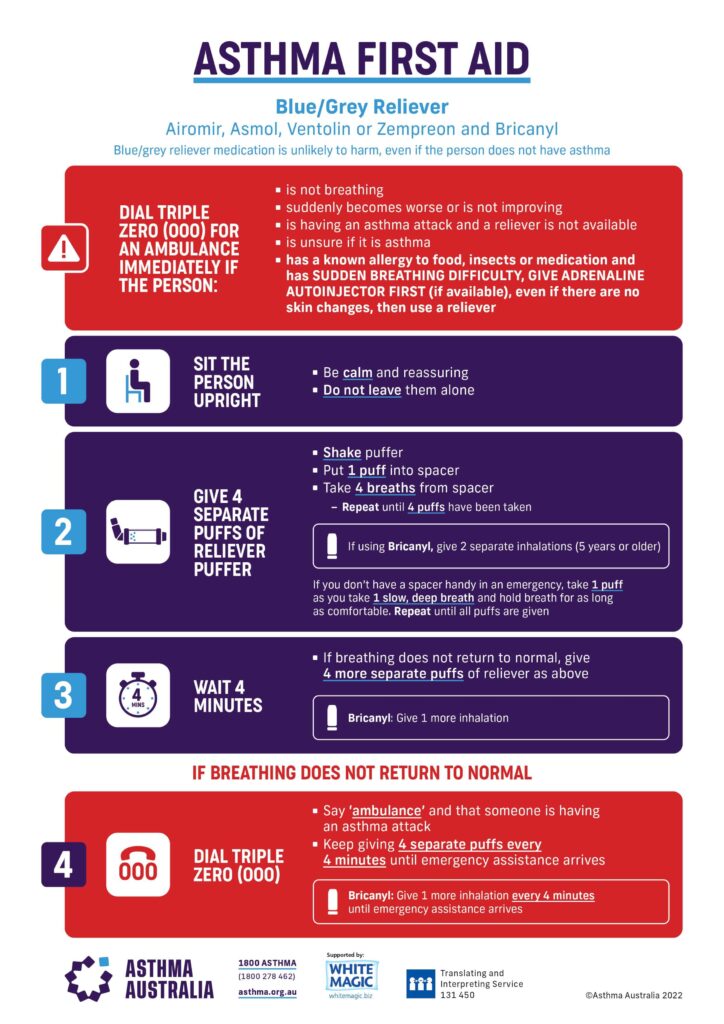
Asthma first aid steps
To use asthma first aid with a blue/grey reliever puffer:
Step 1: Sit the person upright
Be calm and reassuring.
Do not leave them alone.
Step 2: Give 4 separate puffs of blue/grey reliever puffer
Shake the puffer.
Put 1 puff into the spacer.
Get the person to take 4 breaths from the spacer.
Repeat until 4 puffs have been taken. (If you don’t have a spacer, give 1 puff as they take 1 slow, breathe deep and hold for as long as comfortable. Repeat until all puffs are taken.)
Remember: Shake, 1 puff, 4 breaths.
Step 3: Wait 4 minutes
If there is no improvement, give 4 more separate puffs of blue/grey reliever, as with Step 2.
Step 4: If breathing does not return to normal, call triple zero (000) for an ambulance
Tell the operator that someone is having an asthma emergency.
Keep giving the person 4 separate puffs, taking 4 breaths for each puff, every 4 minutes until emergency assistance arrives.
Emergency Asthma Management: Beyond Basic First Aid
You should only do CPR on Someone With Asthma who has stopped breathing and is unresponsive. So, if someone is unconscious, your emergency response should be to start CPR. Combine standard CPR as well as rescue breathing.
Preventing Asthma Attacks: Proactive Measures
If you have asthma, it’s crucial to minimise exposure to triggers. Start by identifying what causes your symptoms like coughing, wheezing, and breathlessness. While there’s no cure, you can control asthma and prevent attacks.
Identify Asthma Triggers: Recognise these asthma triggers:
Air pollution
Allergies
Cold air
Respiratory infections (colds & flu)
Exercise
Sinusitis
Smoke
Fragrances
Pets
- Thunderstorms
Dust mites
Pests (e.g., cockroaches)
Keep an asthma diary for symptoms.
Avoid Allergens: If you have allergies and asthma, stay away from allergens to reduce inflammation and asthma attacks.
Say No to Smoke: Limit exposure to all smoke sources: tobacco, incense, candles, fires, and fireworks. Don’t smoke, and avoid places that permit it.
Prevent Colds: Where possible, avoid close contact with sick people to prevent worsened asthma symptoms. Wash your hands thoroughly.
Allergy-Proof Your Home:
Wash bedding in hot water weekly
Use a dehumidifier/air conditioner (30%-50% humidity)
Remove bedroom carpets
Vacuum regularly (if possible, stay away until after any dust that’s been stirred up settles)
Control pests, avoiding using sprays or foggers
Travel Tips:
Reserve a smoke-free hotel room
Avoid smoky restaurants
Get Vaccinated:
Get your flu shot annually
Consider pneumonia shots (per CDC recommendations).
Stay protected against other infections
Take Asthma Medications: Consistently use long-term medications to prevent symptoms and attacks. Discuss side effects with your doctor.
Follow Your Asthma Action Plan: Adhere to your action plan, keep an inhaler on hand, and follow instructions during symptoms or attacks.
In summary
Recognising and responding promptly to asthma flare-ups, even during rapid-onset attacks, is crucial in preventing potential asthma emergencies. Ensure you have an updated asthma action plan and familiarity with the 4 essential steps of asthma first aid for effective asthma management.