




Choking first aid involves emergency techniques to clear a blocked airway when someone cannot breathe due to an obstruction. When someone is choking, quick action using back blows and chest thrusts can save a life by dislodging the blockage and restoring normal breathing.
Choking is a life-threatening emergency that can happen to anyone, anywhere, at any time. Whether it’s a young child putting small objects in their mouth, an adult swallowing a piece of food too quickly, or an elderly person with swallowing difficulties, knowing how to respond can mean the difference between life and death. In Australia, choking incidents send hundreds of people to hospital each year, and tragically, some result in permanent brain damage or death when the airway remains blocked for too long.
This comprehensive guide provides essential first aid advice for managing choking emergencies in adults, children, and infants. You’ll learn to recognise the signs and symptoms of choking, perform life-saving techniques correctly, and understand when to call Triple Zero (000) for medical aid.
Ready to gain confidence in emergency situations? Enrol in a nationally recognised first aid course with First Aid Pro and learn hands-on choking first aid techniques from experienced instructors. Our courses meet Australian standards and provide you with the first aid skills you need to respond effectively.

Key Takeaways
- Recognise choking immediately: Look for the universal choking sign (hands clutching the throat) and inability to speak or breathe
- Encourage coughing: If the person can cough forcefully, let them try to clear the blockage themselves
- Use back blows first: Give up to 5 sharp back blows between the shoulder blades
- Follow with chest thrusts: If back blows fail, give up to 5 chest thrusts
- Continue alternating: Keep alternating 5 back blows with 5 chest thrusts until the blockage clears or help arrives
- Call Triple Zero (000): If the blockage has not cleared after 5 cycles, or if the person becomes unconscious
- Start CPR if unconscious: If someone who is choking becomes unresponsive and not breathing, start CPR immediately

What Is Choking and How Does It Happen?
A choke occurs when an object becomes lodged in the throat or airway, blocking the flow of air to the lungs. This obstruction prevents the person from breathing normally and, without intervention, can cause brain damage or death within minutes due to oxygen deprivation.
Common Causes of Choking in Adults and Children
In Adults
- Large pieces of meat or steak
- Hard lollies or boiled sweets
- Nuts and seeds
- Raw vegetables (carrots, celery)
- Pills or tablets
- Dentures or dental work becoming dislodged
In Children
- Small toys or toy parts smaller than a 20-cent coin
- Coins, buttons, and batteries
- Balloons and balloon pieces
- Hard lollies and chewing gum
- Whole grapes, cherry tomatoes
- Popcorn and nuts
- Hot dogs and sausages
Special Risk Factors
- Children under three years who commonly put things in their mouths
- Elderly individuals with swallowing difficulties
- People with neurological conditions
- Eating too quickly or talking while eating
- Consuming alcohol, which impairs swallowing reflexes
Recognising the Signs and Symptoms of Choking

Quick recognition of choking symptoms is critical for providing timely first aid for choking. Understanding the difference between mild and severe obstruction determines your response.
Mild Airway Obstruction | Severe Airway Obstruction |
Can speak and cough forcefully | Cannot speak or can only make high-pitched sounds |
Making breathing sounds | Silent or making whistling sounds |
May be distressed but responding | Clutching throat (universal choking sign) |
Airways partially blocked | Cannot breathe or cough effectively |
Skin colour normal | Skin turning blue (cyanosis) |
What to Do for a Choking Casualty
Mild obstruction
Encourage the person to keep coughing.
Do not slap a choking person on the back or interfere if they can cough effectively.
Severe obstruction
Act immediately with back blows and chest thrusts.
The person cannot wait to clear the blockage themselves.

Choking First Aid Techniques for Adults
When an adult or child over 1 year cannot breathe and requires assistance, follow this systematic approach for first aid advice.
How to Perform Back Blows for Choking in Adults
Back blows are the first line of treatment for someone who is choking with a complete airway blockage.
Step-by-Step Instructions:
- Assess and reassure: Ask the person “Are you choking?” If they nod but cannot speak, proceed immediately.
- Position the person: Bend the person forward at the waist so their head is lower than their chest. This position helps gravity assist in dislodging the blockage.
- Support the chest: Stand to the side and slightly behind. Use one hand to support their chest, keeping them bent forward.
- Deliver back blows: Using the heel of your other hand, give up to 5 sharp blows between the shoulder blades. Each blow should be firm and delivered with the intent to dislodge the obstruction.
- Check between blows: After each back blow, check if the blockage has cleared. Stop if the person starts breathing normally or coughing effectively.
How to Perform Chest Thrusts for Choking in Adults
If back blows do not clear the blockage, immediately proceed to chest thrusts.
Step-by-Step Instructions:
- Position yourself: Stand behind the person (or kneel if they're seated).
- Find hand placement: Place one hand in the middle of their back for support. Make a fist with your other hand and place it against the centre of their chest at the breastbone level.
- Deliver thrusts: Pull sharply inward and upward. Give up to 5 chest thrusts, checking between each thrust.
- Continue alternating: If the blockage has not cleared after 5 chest thrusts, return to giving 5 back blows. Continue alternating 5 back blows with 5 chest thrusts until medical aid arrives or the obstruction clears.
- Call for help: If someone else is present, have them call Triple Zero (000) immediately. If alone, complete one cycle of back blows and chest thrusts before calling.
Important Note: In Australia, we do not use abdominal thrusts (also called the Heimlich manoeuvre) as a first-line treatment. Abdominal thrusts carry a higher risk of injury to the ribs and damage to internal organs. Australian Resuscitation Council guidelines recommend back blows followed by chest thrusts instead.
Special Considerations for Pregnant or Obese Adults
For heavily pregnant women or individuals with obesity where you cannot position your hands effectively:
- Use chest thrusts only (never abdominal thrusts)
- Modify hand placement to ensure you can deliver effective thrusts
- Ensure your fist is positioned on the breastbone, not over the ribs or abdomen
Build life-saving confidence today. Join a nationally recognised first aid course with First Aid Pro and practise choking first aid techniques on training manikins under expert guidance. Learn first aid skills that could save someone you love.
Choking First Aid Techniques for Children (1 to 8 Years)
The technique for child choking is similar to adults but requires modifications for their smaller body size.
Back Blows and Chest Thrusts for Choking in Children
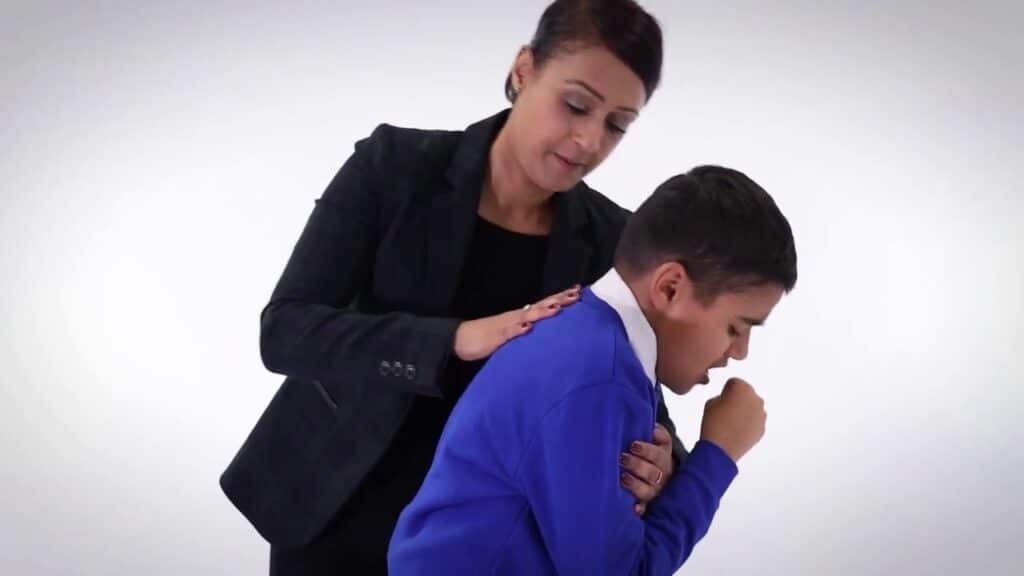
Back Blows for Choking in Children
- Kneel or bend to the child's level
- Position the child: bend them forward, supporting their chest with your hand or knee
- Ensure the head is lower than their chest to assist gravity
- Give up to 5 back blows between the shoulder blades using the heel of one hand
- Use appropriate force: firm enough to dislodge the obstruction but adjusted for the child's size
Chest Thrusts for Choking in Children
- Position yourself behind the child
- Make a fist and place it in the centre of their chest
- Give up to 5 chest thrusts, pulling inward and upward
- Continue alternating 5 back blows and 5 chest thrusts if needed
- Call Triple Zero (000) if the blockage cannot be cleared

Choking First Aid for Infants (Under 1 Year)
Infants require a gentler approach due to their fragile anatomy. Never use chest thrusts until medical aid arrives on an infant—the technique differs significantly.
Back Blows and Chest Thrusts for Choking in Infants
Back Blows for Choking in Infants
- Position the infant face-down along your forearm.
- Support the head and neck: keep the baby's head lower than their body.
- Rest your arm on your thigh for stability.
- Give up to 5 back blows using the heel of one hand between the shoulder blades.
- Use gentle but firm force appropriate for an infant.
Chest Thrusts for Infants
- Turn the infant face-up along your other forearm, supporting the head.
- Keep the head lower than the body.
- Use two fingers (not a fist) in the centre of the chest.
- Give up to 5 chest thrusts, pushing down and then releasing.
- Continue alternating 5 back blows with 5 chest thrusts.
Critical: For infants, the technique uses two fingers for chest compressions, not a fist as with older children and adults.

What to Do If the Person Becomes Unconscious
If someone who is choking becomes unconscious and stops breathing, immediately start CPR.
Steps to Follow:
- Call Triple Zero (000) immediately (or have someone else call)
- Lower the person to the ground carefully
- Start CPR: Begin chest compressions (30 compressions)
- Check the mouth: Before giving rescue breaths, look in the mouth. If you can see the object, remove it. Never perform a blind finger sweep.
- Give 2 rescue breaths
- Continue CPR cycles of 30 compressions (at a rate of 100-120 compressions per minute) and 2 breaths until the person starts breathing or medical aid arrives
Each compression may help dislodge the blockage. Checking the mouth between cycles may reveal the object has been freed.
What Not to Do During a Choking Emergency
Knowing what to avoid is just as important as knowing the correct first aid for choking:
Don’t Do This | Why It’s Dangerous |
Blind finger sweeps | Can push the object deeper into the airway |
Give water | The person cannot swallow and may aspirate fluid |
Slap the back randomly | Must be firm, directed blows between shoulder blades |
Interfere with effective coughing | If they can cough forcefully, this is most effective |
Delay calling Triple Zero | The person needs advanced medical aid if initial attempts fail |
Perform abdominal thrusts as first aid | Not recommended in Australia; risk of internal injury |
Preventing Choking Incidents
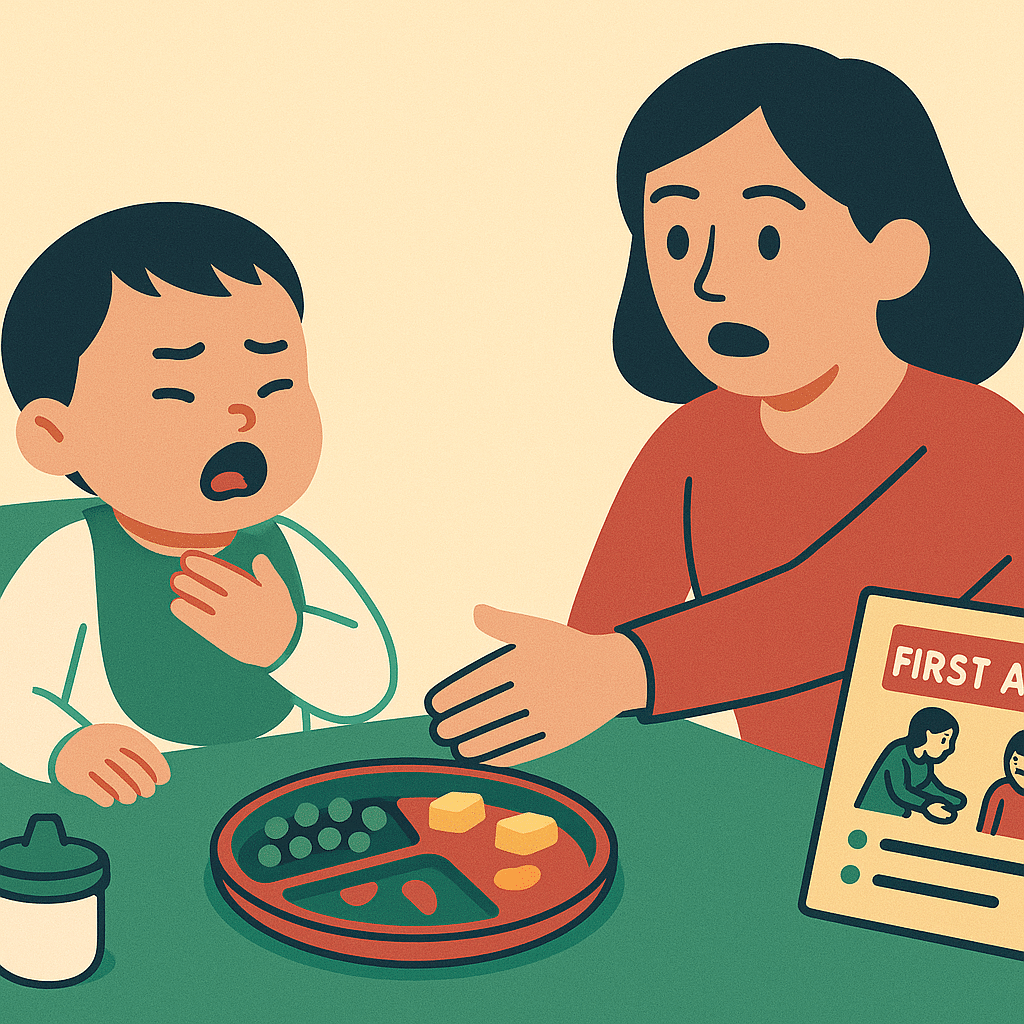
While knowing choking first aid is essential, prevention helps reduce the risk of choking incidents.
Help Prevent Choking in Children and Adults
Help Prevent Choking in Children
- Supervise mealtimes: Always watch young children while they eat.
- Cut food appropriately: Slice grapes, cherry tomatoes, and sausages lengthwise.
- Avoid common choking hazards: Keep small objects, coins, and buttons away from children under three years.
- Teach safe eating: Encourage sitting while eating, chewing thoroughly, and not talking with mouths full.
- Choose age-appropriate toys: Ensure toys do not have small parts smaller than a 20-cent coin.
- Keep dangerous items away: balloons, button batteries, and magnets pose significant risks.
Choking Prevention for Adults
- Eat slowly and chew thoroughly: Take smaller bites and chew food completely.
- Avoid talking while eating: Do not laugh or talk with food in your mouth.
- Limit alcohol: Alcohol impairs swallowing reflexes and judgment.
- Cut food appropriately: Particularly tough meats should be in manageable pieces.
- Be mindful of dental work: Loose dentures can create choking risks.
- Stay seated while eating: Do not eat while walking or lying down.
When to Seek Medical Attention After Choking
Even if the blockage has been cleared and the person seems fine, medical assessment may be necessary:
Seek immediate medical attention if:
- The person was unconscious at any point
- Back blows and chest thrusts were used (potential for internal injury)
- The person is coughing persistently or has breathing difficulties
- There’s a possibility some of the object remains in the airway
- The person is coughing up blood
- The person has chest or throat pain
Chest thrusts can cause rib fractures or internal injuries even when performed correctly. A medical professional should assess anyone who received this type of first aid.
Don’t wait for an emergency to learn these critical skills. Enrol in a nationally recognised first aid course with First Aid Pro today. Our comprehensive training covers choking first aid, CPR, and other essential emergency responses that help you respond confidently when seconds count.
Knowledge Test Quiz: Choking First Aid
Test your understanding of choking first aid with this quick quiz.
1. What should you do first when an adult is choking but can cough forcefully?
2. How many back blows should you give before checking or moving to chest thrusts?
3. What position should the person's head be in when giving back blows?
4. What do you use for chest thrusts on an infant?
5. If someone who is choking becomes unresponsive and not breathing, what do you do?
Choking First Aid: Essential Steps to Save a Life
Choking is a frightening emergency, but with the right knowledge and first aid skills, you can respond effectively and potentially save a life. Remember the key steps: encourage effective coughing if possible, give up to 5 sharp back blows between the shoulder blades, follow with up to 5 chest thrusts if needed, and continue alternating until the blockage clears or medical aid arrives. Always ensure the person’s head is lower than their body during back blows, and don’t hesitate to call Triple Zero (000) if the blockage cannot be cleared.
Whether you’re a parent, caregiver, teacher, or simply want to be prepared, understanding how to respond when someone is choking is a fundamental life skill. Prevention is equally important—supervise young children during meals, avoid common choking hazards, and encourage safe eating practices across all age groups.
The techniques outlined in this guide follow Australian Resuscitation Council guidelines and represent best practice for choking first aid in Australia. However, nothing replaces hands-on training where you can practise these skills under expert supervision and receive feedback on your technique.
Don’t leave your preparedness to chance. Learn first aid through a nationally recognised course and gain the confidence to act decisively in emergencies. When someone cannot breathe, every second counts—your knowledge and quick action could be the difference between tragedy and survival.
References
- Australian Resuscitation Council (2024). Guidelines: Basic Life Support
- Kidsafe Australia (2024). Choking Prevention Information.
- Royal Children’s Hospital Melbourne (2023). Foreign bodies inhaled
- Better Health Channel: Choking
- Healthdirect: Choking
Frequently Asked Questions
The content on this website offers general insights regarding health conditions and potential treatments. It is not intended as, and should not be construed as, medical advice. If you are facing a medical emergency, dial 000 immediately and follow the guidance provided.
Recent Posts
National First Aid Course – Online & In-Person CPR, HLTAID011 Training Near You
An Australian National First Aid Course teaches you how to respond safely and confidently during

White Card Certificate Explained: What It Is, How It Works, and Why You Need One
A white card certificate, officially known as the General Construction Induction Card, is a legal

Dog Bite – Symptoms, Risks & First Aid
A dog bite is an injury caused when a dog’s teeth break the skin, creating

11379NAT vs Mental Health First Aid Course: Accredited Crisis Response Training Explained
The 11379NAT Course in Initial Response to a Mental Health Crisis is a nationally recognised

LVR Training Update 2025: Key Differences Between UETDRRF004, UETDRMP007, and UETDRMP018
Low Voltage Rescue (LVR) training is the nationally recognised skillset that teaches workers how to